10,2241
Tests
the collected checks that pin this engine's behavior
ENGINE 52
SFS-E52-BDR · BUDGET INTEGRITY · REV 2026-08-26 · PRODUCTION
PRODUCTION = runnable end-to-end, CI-backed, full test suite passing. All data fictional and seeded.
Four copies of one budget, each internally perfect, reconciled against one another.
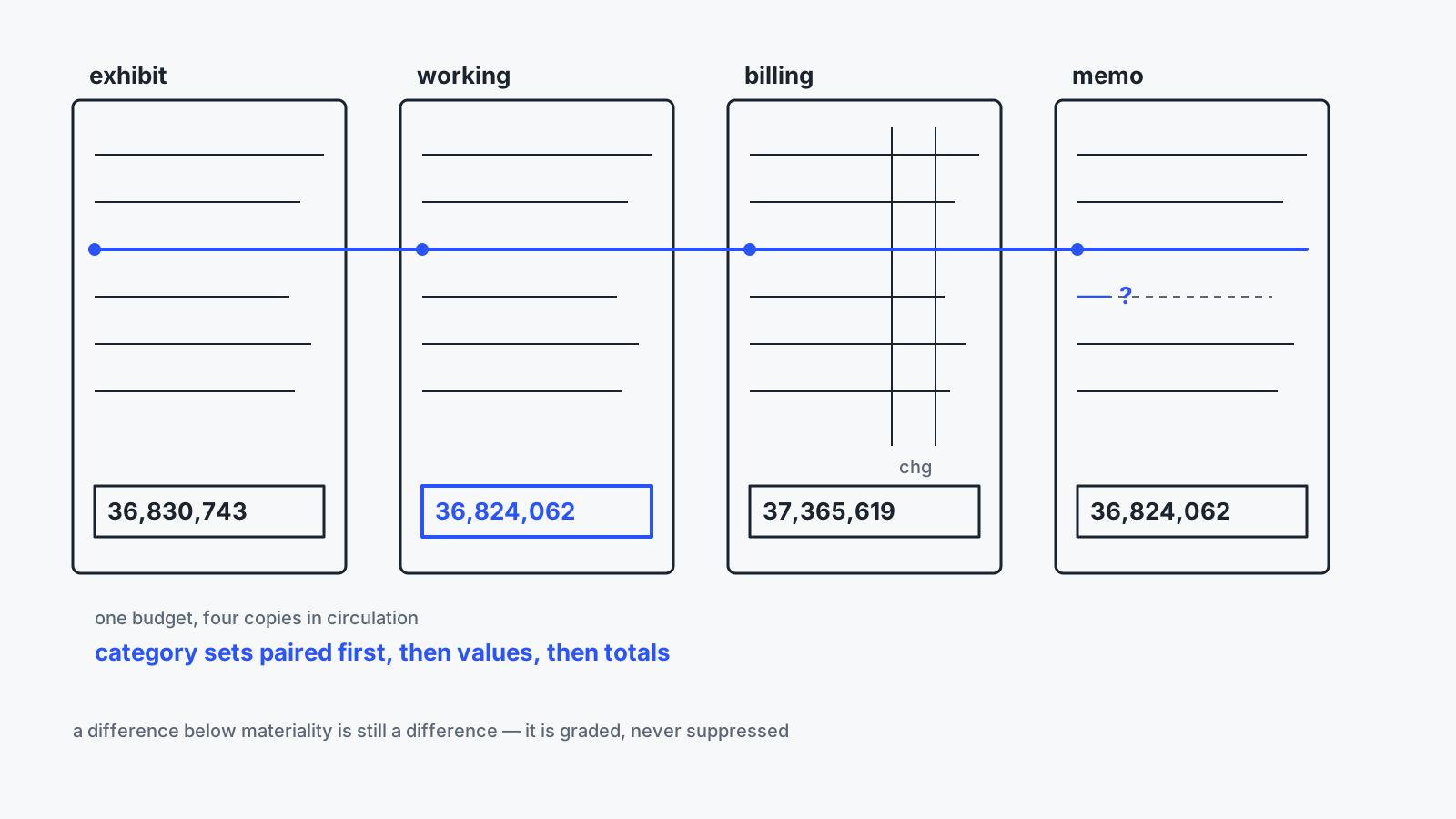
A joint venture is signed against a contractual exhibit. The sponsor maintains a working model. Draws are billed on an instrument carrying approved-plus-changes columns. A summary memo goes to a lender. Four copies of one budget -- and each can foot perfectly, re-derive its own margin, balance sources against uses, and still disagree with the other three. This engine reads the six artifacts a reporting cycle emits -- the governing agreement, every budget version in circulation, the amendment log, the milestone set, the derived schedules and the funding register -- and runs twenty-five deterministic controls across them. Is every artifact present and the period legible, does every version declare an id and a role and a prepared date, is there exactly one contractual baseline and does the agreement name it, was that baseline prepared on or after the agreement it is an exhibit to, was any version prepared after the period it reports on, do the category sets reconcile in both directions, does every paired line agree with the baseline, is a sub-threshold difference still surfaced, does every version's derived total equal the baseline's and its own stated figure, do the phase totals foot with no unphased line, are offsetting movements graded as re-carves rather than changes, is each reporting copy current to within the file's staleness band, does a summary predate the working model it restates, does every billing line re-derive from approved plus previous plus current, does every current change trace to an approved amendment for its exact amount, has a pending amendment been billed as though approved, has a locked line moved in any copy, does every schedule input exist and carry a date, do the instalments conserve the base over the declared periods, is the base net of advances taken, are advances inside the cap, do member commitments agree across copies, does the funding split match the agreement's ratio for the declared phase, and is every member inside commitment and cap. Every comparison is exact == in integer cents, and every date is tested against the reporting period the file carries rather than the system clock.
Every within-document control in a finance stack asks the same question: does this workbook foot? Four copies of one budget can each answer yes and still disagree by half a million. That is not a hypothetical failure mode; it is the ordinary condition of a project that has been running long enough to have a contractual exhibit, a working model that has moved since, a billing form carrying its own change columns, and a memo somebody circulated last quarter. Each artifact is maintained by a different person for a different purpose, each is internally consistent, and nothing in the stack compares them. The failures that follow are quiet by construction. A reclassification -- two lines moving by equal and opposite amounts -- reads as a change and buries the genuine ones. A line renamed in one copy has no counterpart in another, so a comparison that pairs on names walks straight past the line that moved. A copy goes stale rather than wrong: it was right when it was prepared, its cost-through date is months behind, and every figure read off it since has been quoted with confidence. A derived schedule loses a milestone and does not error -- it silently keeps its last amortisation. This engine is the reconciliation nobody performs: category sets paired before values, totals summed from lines rather than read from a stated figure, offsetting movements graded separately from changes, every movement traced to an approved amendment, and a materiality threshold used only to grade a difference that has already been found -- never to decide whether one exists.
Seven control families run in registry order over each cycle file. The first proves the others had something to read, because a control that passes on absent evidence reports assurance it never performed.
A project budget does not exist once. It exists as a contractual exhibit the venture was signed against, a working model the sponsor maintains, a billing instrument draws are requested on, and a summary memo circulated to a lender -- four copies, four owners, four purposes. Each is internally consistent. Sources equal uses in all of them, each re-derives its own margin, each foots. Nothing in an ordinary finance stack compares them to one another, and five failures live in that gap. First, a copy is materially wrong while being internally perfect: the totals simply differ, and no within-document control can see it. Second, a reclassification reads as a change -- two lines move by equal and opposite amounts, the total never budges, and grading that as a budget revision buries the genuine revisions among the noise. Third, a category exists in one copy and not another, because a line was renamed or split; a comparison that walks one version's lines and looks each up in the other returns clean on everything it can pair and skips the one that moved. Fourth, a copy is stale rather than wrong: it was right when it was prepared, its cost-through date is months behind the period being reported, or its prepared date falls before the agreement it purports to be an exhibit to, and every figure read off it since has been quoted with confidence. Fifth, a derived schedule loses its inputs -- a fee amortised across a construction period depends on milestone dates, and blanking a milestone does not raise an error, it silently leaves the schedule on its last amortisation while the instalment it drives stops matching the term it spans. None of these announce themselves. Each survives every check that looks inside a single document, which is why the reconciliation between documents has to be a control of its own.
The seeded demo runs every control over every cycle file6. The CLI generates twenty-seven fictional cycle files -- one clean baseline and one carrying each of the twenty-six planted defects -- then runs all twenty-five controls over each. The clean file returns PASS with no flags; every defect file returns REVIEW or FAIL and names the control it tripped along with the reason that control exists.
Two lines move in opposite directions and the total holds7. One planted defect moves an amount out of one category and into another in the working model, leaving the grand total untouched. The engine grades it as a reclassification rather than a change, so it surfaces for review as a re-carve that still needs an approval behind it, instead of appearing in the same list as the genuine budget movements.
A category is renamed in one copy and the comparison does not skip it8. One planted defect renames a category in the working model. Because the category sets are reconciled in both directions before any value is compared, the engine reports the line as present in the baseline and absent from the copy -- rather than pairing on names, finding no match, and silently comparing everything else.
A milestone is blanked and the schedule keeps paying9. One planted defect removes the date from a milestone a fee amortisation declares as an input. The schedule does not error and its instalments still sum to its base, so every arithmetic control on it holds. The engine fails it anyway, because the term the amortisation spans is no longer defined.
A difference below materiality is reported rather than suppressed10. A sub-threshold line difference is carried as a review flag, not dropped. The materiality threshold grades a difference the engine has already found with exact ==; it never decides whether a difference exists, because a line nobody reconciles is how a small difference becomes a large one.
| Command | Operation | Output | Exit | Artifacts |
|---|---|---|---|---|
python run.py | regenerate the seeded fictional corpus, run all twenty-five controls, write both reports | per-file verdicts and every actionable finding, then the overall verdict | 2 for the bundled corpus, which carries a planted defect for every control by design | baseline_report.json, baseline_report.md, samples/ |
python -m baseline_engine samples | analyze an existing folder of cycle files without regenerating it | per-file verdicts and findings | 0 PASS / 1 REVIEW / 2 FAIL / 3 usage | none unless --json or --md is passed |
python -m baseline_engine samples --generate --quiet | regenerate the corpus and print only the overall verdict | a single verdict line | 0 PASS / 1 REVIEW / 2 FAIL / 3 usage | samples/ |
python -m pytest baseline_engine/tests -q | run the engine's own test suite | pytest summary | 0 when every test passes | none |
| Measure | Result |
|---|---|
| Engine tests11 | 10,224 tests collected live collection from the engine directory |
| Registered controls12 | 25 controls counted from the registry, not from documentation |
| Planted defects13 | 26 defect files every registered control has at least one file that trips it |
| Control coverage14 | 100 percent of controls with a planted defect no control ships without a corpus file proving it fires |
A clean result means the implemented mechanical controls found nothing wrong in the set of budget copies they were given: every artifact is present and the period legible, exactly one copy governs and the agreement names it, no copy is dated before the agreement or after the period, the category sets reconcile in both directions, every paired line and every derived total agrees with the baseline, the phase split foots with no unphased line, every reporting copy is current to within the file's staleness band, every billing line re-derives from its own change columns and traces to an approved amendment for its exact amount, no pending amendment has been billed, no locked line has moved, every derived schedule's inputs exist and carry dates and its instalments conserve a base net of advances inside its cap, and every member's commitment agrees across copies and matches the phase ratio. It is not an opinion that the budget is correct, complete or approved.
Deterministic envelope. seeded fictional inputs, read-only operation, offline default mode.
Distribution: public repository, MIT license.
One conversation: you describe the work that consumes your team's month; we tell you plainly what this engine can take over, what it can't, and what a scoped first phase would cost. Your people keep approval authority.
Book a free consultation