7,0111
Tests
the checks that pin this engine's behavior
ENGINE 07
SFS-E07-KBN · CITED KNOWLEDGE · REV 2026-07-20 · PRODUCTION
PRODUCTION = runnable end-to-end, CI-backed, full test suite passing. All data fictional.
Queryable institutional memory with a citation on every answer — or no answer
Knowledge Brain turns fictional meeting transcripts into a deterministic TF-IDF index for cited questions, paste-ready footnotes, meeting prep, and review-remediation handoffs. Its remediation path generates a cited, apply-ready prompt and a PENDING change log; a downstream AI or operator owns execution and confirmation of the workpaper changes.
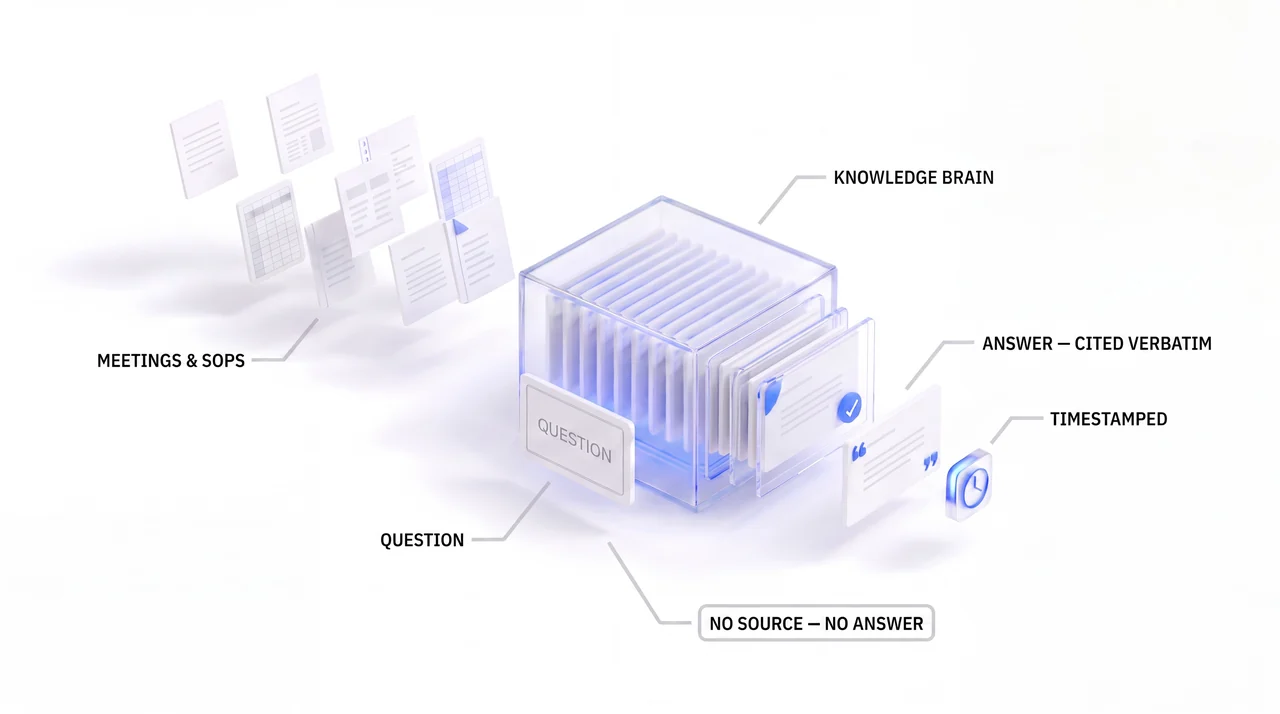
A knowledge system earns trust by carrying each quote back to its meeting, date, timestamp, and speaker — and by refusing to answer when no source clears the relevance floor.
The stack preserves chain of custody from the transcript of record through retrieval and the downstream handoff. Select a layer for its plain-terms and engineering detail.
Finance and tax decisions often survive only as meeting memory or buried notes. When the same position is needed in a workpaper, disclosure, or review response, an uncited paraphrase is not enough: the user needs the recorded words, who said them, and when — or an explicit refusal when the source is absent.
A workpaper assertion gets one traceable footnote7. Cite mode filters out open items, returns the best authoritative card, and renders its transcript text byte-identically with the meeting title, date, timestamp, and speaker attached.
An off-topic question produces a machine-readable refusal8. When no card clears the relevance floor, the CLI prints “No sourced answer — the brain does not guess” and exits 3 instead of filling the gap with a plausible answer.
A review meeting becomes a cited prompt, not an untracked edit9. The remediation command retrieves four fictional reviewer directives in spoken order and generates an apply-ready prompt plus a one-to-one change log at PENDING. A downstream AI or operator performs the edits and confirms their status.
Stored knowledge drift is re-derived only where the transcript supports it10. The integrity demo starts with four injected findings, re-derives three text-or-speaker corrections across two turns, and leaves the orphaned citation quarantined. The final verdict is ESCALATED with exit 3 because no utterance exists to support that record.
| Command | Operation | Output | Exit | Artifacts |
|---|---|---|---|---|
python -m brain_engine | print the fictional corpus index | meeting, card-kind, topic, and provenance catalogue | 0 | none |
python -m brain_engine ask "<question>" | retrieve the best cited cards for a question | ranked cited answer(s) or explicit refusal | 0 sourced · 3 refusal | none |
python -m brain_engine "<question>" | use the equivalent bare-question form | ranked cited answer(s) or explicit refusal | 0 sourced · 3 refusal | none |
python -m brain_engine --cite "<assertion>" | return one paste-ready authoritative footnote | verbatim quote + provenance tag or refusal | 0 sourced · 3 refusal | none |
python -m brain_engine --prep "<topic>" | assemble cited prior positions and open items | meeting-prep briefing or refusal | 0 sourced · 3 refusal | none |
python -m brain_engine remediate "<review>" | generate a cited apply-ready remediation handoff | ordered directives + generated prompt | 0 sourced · 3 refusal · 2 missing topic | none |
python -m brain_engine --seed N | accept the compatibility seed argument | the unchanged hand-authored corpus; the current build ignores N | 0 | none |
python -m brain_engine --min-relevance R ask "<question>" | set the retrieval relevance floor | cited hits clearing R or refusal | 0 / 3 · 2 if R is outside [0,1] | none |
python -m brain_engine --out DIR | write all Markdown example deliverables | index, citation, prep, remediation, and change-log files | 0 | DIR/brain_index.md · citation_example.md · meeting_prep_example.md · remediation_prompt.md · change_log.md |
python run.py --out DIR | use the convenience entrypoint | the same five Markdown deliverables | 0 | DIR/*.md |
python -m brain_engine.loop | compare the clean knowledge corpus with its transcripts | CLEAN integrity-loop report | 0 | none |
python -m brain_engine.loop --demo | inject the documented internal knowledge-drift profile | ESCALATED after supported drift is re-derived and the orphan is held | 3 | none |
python -m brain_engine.loop --seed N | accept the loop's compatibility seed argument | the same fixed-corpus integrity verdict; the current build ignores N | 0 / 3 | none |
python -m brain_engine.loop --budget N | cap internal knowledge-remediation turns | final CLEAN, REMEDIATED, or ESCALATED verdict | 0 / 3 | none |
python -m brain_engine.loop --out DIR | write the knowledge-integrity report | integrity-loop verdict and report | 0 / 3 | DIR/integrity_loop_report.md |
python -m pytest -q | run the engine test suite | pytest session summary | 0 | none |
| Measure | Result |
|---|---|
| Engine tests11 | 7,011 tests live collection, not the README's historical sample output |
| Indexed fictional corpus12 | 15 knowledge cards across 5 meetings |
| Review handoff13 | 4 cited directives mapped one-to-one to PENDING entries |
| Integrity demo recovery14 | 3 corrections over 2 turns; 1 orphan quarantined |
Every returned answer is tied to a recorded source. The remediation boundary ends with the generated cited prompt and PENDING log; execution and confirmation belong to the downstream user or system.
Deterministic envelope. offline default mode.
| Severity | Verdict | Action |
|---|---|---|
| No internal knowledge drift | CLEAN | nothing is changed; exit 0 |
| All internal drift has transcript support | REMEDIATED | stored text or speaker is re-derived verbatim; exit 0 |
| Orphaned source or turn budget exhausted | ESCALATED | unsupported entries are held for a human; exit 3 |
Ask. returns the best relevant cards with citation blocks, or refuses when no card clears the floor
Cite. returns one authoritative decision, rule, or definition as a paste-ready footnote; open items are excluded
Prep. groups relevant authoritative positions separately from open items for meeting preparation
Remediate. generates the cited apply-ready prompt and PENDING change-log handoff from recorded review directives
Integrity loop. compares stored cards and directives with the transcript of record, re-derives supported drift, and quarantines orphaned citations
Distribution: public repository, MIT license.
One conversation: you describe the work that consumes your team's month; we tell you plainly what this engine can take over, what it can't, and what a scoped first phase would cost. Your people keep approval authority.
Book a free consultation