10,3231
Tests
the collected checks that pin this engine's behavior
ENGINE 39
SFS-E39-CAP · COST CAPITALIZATION · REV 2026-07-24 · PRODUCTION
PRODUCTION = runnable end-to-end, CI-backed, full test suite passing. All data fictional and seeded.
Does the interest each project capitalized re-derive from the expenditures and the rate?
A developer that builds designated property with borrowed money cannot deduct all of the interest it pays. Under the avoided-cost method of IRC §263A(f), the interest production could have avoided -- the period rate applied to the accumulated production expenditures tied up in a project -- is capitalized into that property's basis, and only the remainder is deducted. The annual schedule lays every active project across a grid of calendar quarter-ends, pulls each project's interest expense by quarter, and computes that split, and it is rebuilt every fiscal year. This engine reads the five tabs the schedule emits -- the entity trial balance, the project status roster, the project data tab carrying the accumulated production expenditures and the period rate, the interest-by-year tab carrying interest, capitalized and deducted by quarter, and the year-over-year comparison -- and runs nineteen deterministic controls over them. Is the file complete over a readable quarter grid, are the project keys unique, named and in a known status, does every project carrying an interest balance on the trial balance reach the schedule, are the expenditures present for every quarter, non-negative and non-decreasing, is each capitalization rate a valid basis-point rate and is one rate applied across the whole period, does each quarter's capitalized interest re-derive as that rate applied to that quarter's accumulated expenditures, does the split close without leakage, does it stay within the interest actually incurred, do the quarterly columns foot to the stated annual totals, has a project placed in service stopped capitalizing, does the comparison tie the schedule's annual capitalized figure and roll the prior year's balance forward, and do the schedule's total capitalized and project count recompute from the projects they summarise. Every tie is compared with exact ==, amounts are integer cents that are never coerced into the figure the engine is meant to audit, and no source artifact is ever written.
An interest-capitalization schedule is the most reviewable-looking workpaper a developer keeps: four columns, one row per project, a grid of quarters that foots. That is exactly why it drifts. None of the ways it goes wrong look wrong in a grid of quarters. A quarter is edited and the annual total beside it is not re-added, so the row stops footing while the schedule still looks complete. The interest a project incurred no longer equals its capitalized portion plus its deducted portion, so a slice of interest is capitalized nowhere and deducted nowhere -- it has simply left the schedule. A construction project carrying an interest balance on the trial balance never reaches the roster, so its interest is deducted in full, none is capitalized, and nothing in the workbook notices. And the capitalized column itself -- the number that goes into basis and stays there for the life of the asset -- is typed rather than recomputed, or one project is rolled at a rate the others were not, or the comparison never carries last year's balance forward. The engine rebuilds every capitalized figure from the accumulated production expenditures and the period rate through the same kernel that produced the data, compares with exact ==, proves the roster against the trial balance rather than against itself, ships a planted-defect file for every registered control, and states its benchmark as a command rather than a claim. Interest capitalized into basis on a figure nobody re-derived is a misstatement that compounds every year the asset is held.
Six control families run in registry order over each capitalization file. The first proves the others had something to read -- every tab present and a legible quarter grid -- because a control that passes on absent evidence reports assurance it never performed.
A real-estate developer that builds designated property with borrowed money may not deduct all of the interest it pays. Under the avoided-cost method of IRC §263A(f), the interest production could have avoided -- the period rate applied to the accumulated production expenditures tied up in a project -- must be capitalized into that property's basis rather than deducted in the year paid, and the rest is deducted. The annual schedule lays every active project across a grid of calendar quarter-ends, pulls each project's interest expense by quarter, and computes that split. It is rebuilt every fiscal year, and it goes stale in ways nobody watches. Four failures hide inside it, none of which look wrong in a grid of quarters. A row stops footing: a quarter column is edited and the annual total beside it is not re-added, so the interest, capitalized and deducted columns no longer cross-foot while the schedule still looks complete. The split leaks: the interest a project incurred no longer equals its capitalized portion plus its deducted portion, so a slice of interest is neither capitalized into basis nor deducted -- it has left the schedule. A project is missing: a construction project carrying an interest balance on the entity trial balance never reaches the roster, so its interest is deducted in full and none is capitalized. And the capitalized figure is asserted rather than derived: it is typed in instead of recomputed as accumulated production expenditures times the period rate rolled by quarter, or one project is rolled at a rate the others were not, or the comparison never carries the prior year's capitalized balance forward. None of these are judgment calls. They are equalities -- a stated capitalized figure against the rate applied to the expenditures, capitalized plus deducted against the interest incurred, an annual against its quarters, an ending balance against prior plus current -- which a deterministic control settles better than a workbook inherited by whoever rebuilds the schedule this year, and the consequence of missing one stays in basis for the life of the asset.
The seeded demo runs every control over every capitalization file7. The CLI generates twenty-one fictional FY2029 capitalization files -- one clean baseline and one carrying each of the twenty planted defects -- then runs all nineteen controls over each. The clean file returns PASS with no flags; every defect file returns REVIEW or FAIL and names the control it tripped along with the reason that control exists.
The capitalized column is recomputed, not read back8. One defect file raises a project's fourth-quarter accumulated production expenditures without re-deriving the schedule beneath it. Every column still foots, the split still closes, and the annual totals still add -- but cap_rederives rebuilds that quarter's capitalized interest as the period rate applied to the new expenditure balance, finds it is not the figure stated, and fails, proving the capitalized column is derived from the expenditures rather than trusted as written.
Completeness is proved against the trial balance, not against the schedule9. Another defect file adds a project to the entity trial balance that was never added to the roster. Nothing inside the schedule is inconsistent -- every project on it foots, ties and re-derives -- and prj_tb_complete still fails, because the trial balance is the authoritative population and a construction project absent from the schedule has all of its interest deducted and none capitalized.
| Command | Operation | Output | Exit | Artifacts |
|---|---|---|---|---|
python run.py | regenerate the seeded fictional corpus, run all nineteen controls, write both reports | per-file verdicts and every actionable finding, then the overall verdict | 2 for the bundled corpus, which carries a planted defect for every control by design | capitalize_report.json, capitalize_report.md, samples/ |
python -m capitalize_engine samples | analyze an existing folder of capitalization files without regenerating it | per-file verdicts and findings | 0 PASS / 1 REVIEW / 2 FAIL / 3 usage | none unless --json or --md is passed |
python -m capitalize_engine samples --generate --quiet | regenerate the corpus and print only the overall verdict | a single verdict line | 0 PASS / 1 REVIEW / 2 FAIL / 3 usage | samples/ |
python -m pytest capitalize_engine/tests -q | run the full test suite for this engine | 10323 passed | 0 when every test passes | none |
| Measure | Result |
|---|---|
| Engine tests10 | 10,323 tests collected live collection from the engine directory |
| Registered controls11 | 19 controls counted from the registry, not from documentation |
| Planted defects12 | 20 defect files every registered control has at least one file that trips it |
| Control coverage13 | 100 percent of controls with a planted defect no control ships without a file demonstrating it firing |
The engine has no write path and therefore no autonomy to gate. It produces findings; a person decides whether a capitalized figure is carried into basis and whether an in-service date or a missing project is chased.
Deterministic envelope. seeded fictional inputs, read-only operation, offline default mode.
Demo gate. FAIL on the bundled corpus, by design -- it carries a planted defect for every registered control
| Severity | Verdict | Action |
|---|---|---|
| No findings above PASS | PASS | carry the mechanically clean schedule into the documented workpaper review and sign-off |
| One or more FLAG, no FAIL | REVIEW | a human resolves each flag; a project placed in service that is still capitalizing interest lands here, because the in-service date is a judgment the engine cannot adjudicate |
| One or more FAIL | FAIL | the figure is not carried into basis or the return workpaper until the failing control is cleared -- a capitalized figure that does not re-derive, a split that leaks, a row that does not foot, a project missing from the schedule, or a comparison that does not roll forward |
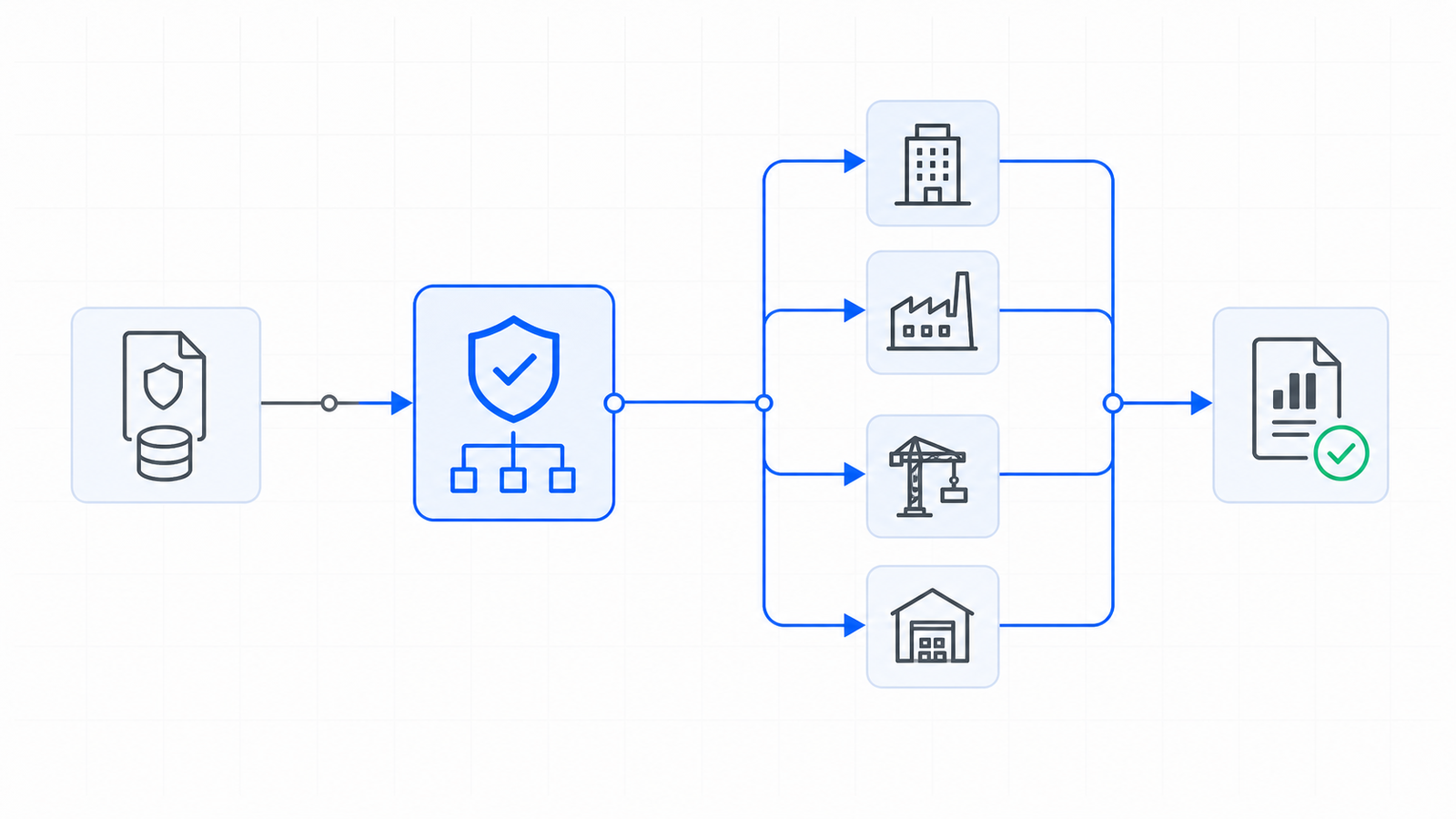
Distribution: public repository, MIT license.
One conversation: you describe the work that consumes your team's month; we tell you plainly what this engine can take over, what it can't, and what a scoped first phase would cost. Your people keep approval authority.
Book a free consultation