10,3921
Tests
the collected checks that pin this engine's behavior
ENGINE 11
SFS-E11-DRW · DRAW CONTROLS · REV 2026-07-22 · PRODUCTION
PRODUCTION = runnable end-to-end, CI-backed, full test suite passing. All data fictional and seeded.
The identity a draw has to prove
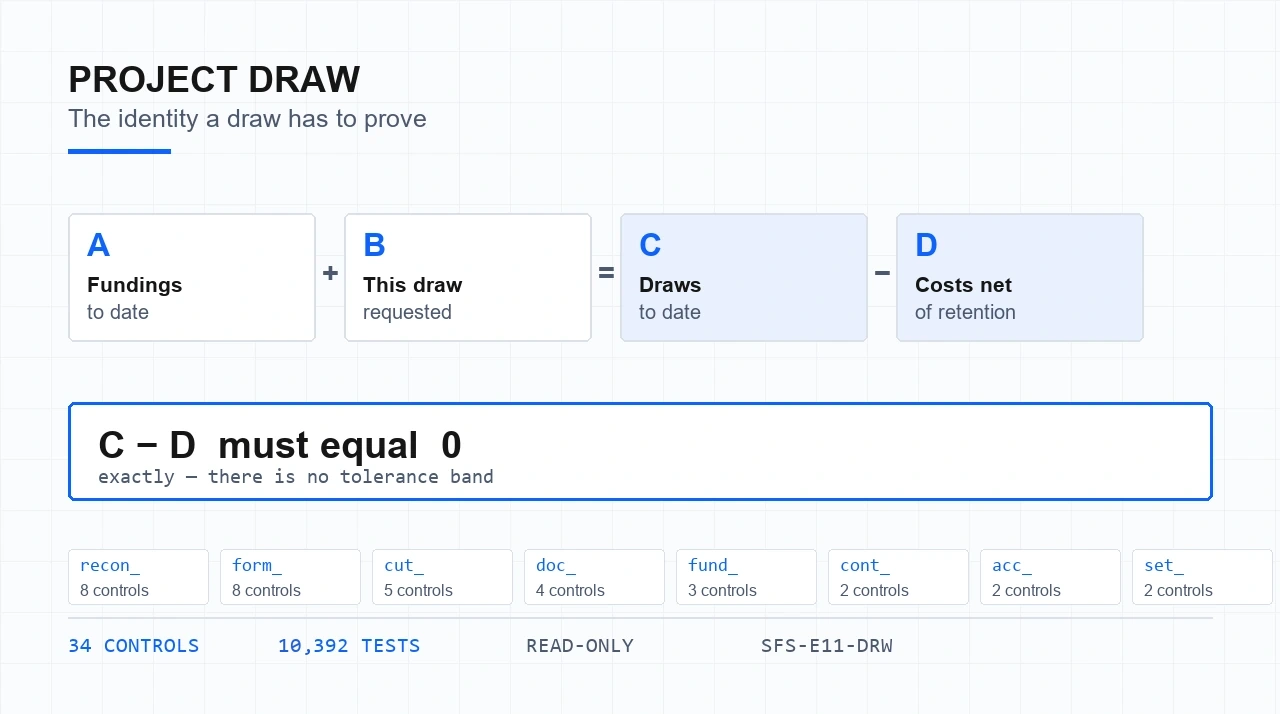
A construction loan draw is the moment a developer asks a lender for money, and it is almost entirely arithmetic. This engine reads the artifacts the draw cycle already emits and runs thirty-four deterministic controls over them: do cumulative draws equal cumulative costs, does the form the lender receives agree with the working paper behind it, was contingency drawn only as fast as the work was earned, and were the costs actually incurred inside the period being billed. It never bills, never funds, and never writes to a source artifact. Every exception it raises ends at a person.
The failure modes here are not exotic, which is exactly why they survive review: a retention release moved in one schedule but not the other, a contingency line drawn faster than the work it covers, a cost posted two days after cutoff and billed anyway. Each is invisible in a spreadsheet and obvious to a rule. The engine ships one planted defect per registered control, so the benchmark is a command rather than a claim.
Eight control families run in registry order over each draw package. The first proves the others had something to read.
Three draw failures recur across development accounting and all three survive review, because each one foots on the page the preparer is looking at. Retention released in the reconciliation but never moved into the current period leaves the schedule internally consistent and the identity broken. Contingency drawn ahead of percent complete looks like an ordinary line item until the final draw arrives with nothing left to fund the work that remains. A cost posted after cutoff and billed anyway creates a reconciliation item that surfaces a month later, by which time the draw it belongs to has already funded. None of the three is exotic; all three are arithmetic, and arithmetic is exactly what a deterministic control asserts better than a reviewer under a deadline.
The seeded demo runs every control over every package7. The CLI generates 37 fictional draw packages -- one clean baseline and one carrying each planted defect -- then runs all 34 controls over each. The clean package returns PASS with no flags; every defect package returns REVIEW or FAIL and names the control it tripped along with the reason that control exists.
One cent of drift fails the reconciliation8. The identity is asserted with integer-cent equality and no tolerance band. Tests move the reconciliation by a single cent in each direction and assert the control fails both times, then restore it and assert the control holds. A control that tolerates a penny has not proved the draw ties.
Contingency cannot authorise itself9. Percent complete is measured on the productive lines of a cost class, excluding the contingency line. A test pushes contingency exactly to its ceiling and asserts it passes, then one cent past and asserts it fails -- which would not hold if the contingency line's own spend inflated the progress that authorises it.
| Command | Operation | Output | Exit | Artifacts |
|---|---|---|---|---|
python run.py | generate the seeded fictional corpus, run all thirty-four controls, write both reports | per-package verdicts and every actionable finding, then the overall verdict | 2 for the bundled corpus, which carries one planted defect per control by design | draw_report.md, draw_report.json, samples/ |
python -m draw_engine samples | analyze an existing folder of draw packages without regenerating it | per-package verdicts and findings | 0 PASS / 1 REVIEW / 2 FAIL / 3 usage | none unless --json or --md is passed |
python -m draw_engine samples --generate --quiet | regenerate the corpus and print only the overall verdict | a single verdict line | 0 PASS / 1 REVIEW / 2 FAIL / 3 usage | samples/ |
python -m pytest | run the full test suite for this engine | 10392 passed | 0 when every test passes | none |
| Measure | Result |
|---|---|
| Engine tests10 | 10,392 tests collected live collection from the engine directory |
| Registered controls11 | 34 controls counted from the registry, not from documentation |
| Planted defects12 | 36 defect packages every registered control has at least one package that trips it |
| Control coverage13 | 100 percent of controls with a planted defect no control ships without a package demonstrating it firing |
The engine has no write path and therefore no autonomy to gate. It produces findings; a person decides.
Deterministic envelope. seeded fictional inputs, read-only operation, offline default mode.
Demo gate. FAIL on the bundled corpus, by design -- it carries one planted defect per registered control
| Severity | Verdict | Action |
|---|---|---|
| No findings above PASS | PASS | send the mechanically clean package to the documented manual review |
| One or more FLAG, no FAIL | REVIEW | a human resolves each flag before submittal; none of them blocks arithmetically |
| One or more FAIL | FAIL | the package does not go to the lender until the failing control is cleared |
Distribution: public repository, MIT license.
One conversation: you describe the work that consumes your team's month; we tell you plainly what this engine can take over, what it can't, and what a scoped first phase would cost. Your people keep approval authority.
Book a free consultation