10,3371
Tests
the collected checks that pin this engine's behavior
ENGINE 28
SFS-E28-FEX · FINANCING EXECUTION · REV 2026-07-24 · PRODUCTION
PRODUCTION = runnable end-to-end, CI-backed, full test suite passing. All data fictional and seeded.
Does each variance re-derive, and does the report tie to the month before it?
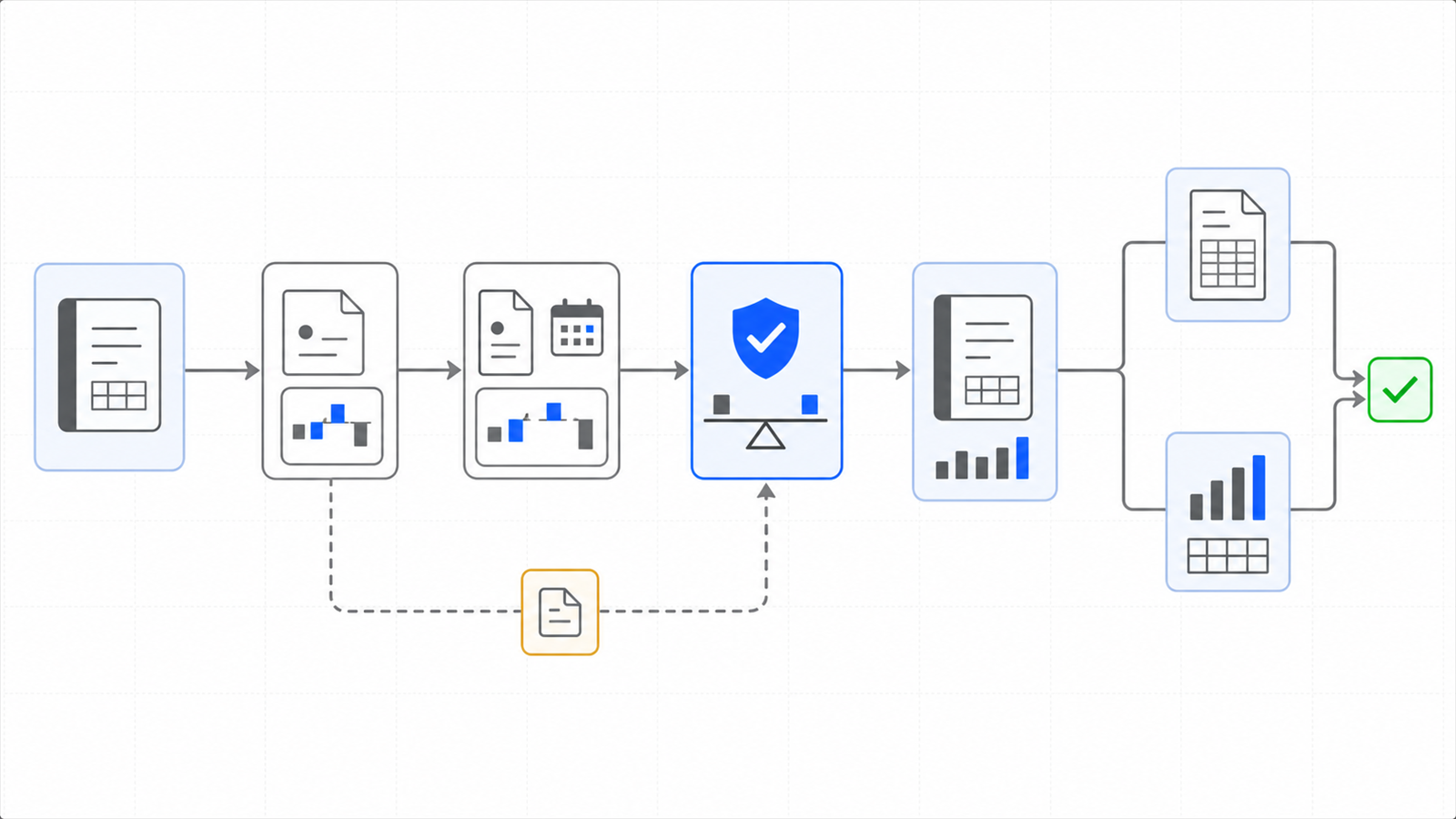
A capital-markets team publishes a monthly "Upcoming Financings" report, and it drifts in ways nobody watches. Each active financing is a workstream -- typed as debt marketing, equity syndication or an extension/refinancing -- carrying an Original | Prior | Current | Variance block of milestone dates, a summary Gantt, and a rollup of the active count, the overdue count and the total capital in flight. This engine reads the seven artifacts that report emits -- the workstream register, the milestone schedule, last month's prior schedule, the playbook catalog, the master tracker, the Gantt summary and the monthly financing report -- and runs twenty-one deterministic controls over them. Is the report complete and the report date readable, are the workstream ids unique, typed and statused, does every milestone name a workstream in the register, does every financing type carry its standard playbook and every active workstream carry each playbook milestone, does the report tie both ways to the master portfolio, are the milestone dates readable, does each variance re-derive as Current minus Prior in whole days, does each Gantt bar sit in its target-closing month, does this month's Prior date equal last month's Current, is the Original baseline frozen across months, is the report date the period-end, does each overdue flag match the date gate of ACTIVE and Current before the report date, are the milestone sequence numbers unique and their current dates non-decreasing, and do the active count, the overdue count and the financing total each recompute from the workstreams they summarise. It compares every variance and every count with exact ==, treats the overdue gate as a strict less-than so a milestone due on the report date is not yet overdue, and never writes to a source artifact.
An "Upcoming Financings" report looks like the safest document a deal team circulates: a grid of dates with a Variance column, a Gantt, and three summary numbers. That is exactly why it drifts. None of the ways it goes wrong look wrong in a spreadsheet. A Current date is hand-edited and the Variance beside it is left behind, so the report says a milestone slipped by a number that no longer matches its own dates. This month's Prior column is quietly overwritten and no longer equals last month's Current, or the Original baseline is re-based, and the report reads current while its history no longer ties. A live workstream is missing one of its financing type's standard milestones, or a project on the master tracker has no workstream in the report at all. And the rollup -- the active count, the overdue list, the total capital in flight -- is stated on a figure nobody recomputed from the workstreams underneath it, while the Gantt draws a bar in a month that is not the month the deal is set to close. The engine rebuilds every variance, every overdue flag, every Gantt month and every rollup count from the base milestone dates and the workstream register through one shared kernel, compares with exact ==, ships a planted-defect file for every registered control, and states its benchmark as a command rather than a claim. A slipped milestone re-based into looking on-plan is invisible until someone walks the Prior column back to the month before it.
Eight control families run in registry order over each financing report. The first proves the others had something to read and that the report date is legible, because a control that passes on absent evidence reports assurance it never performed.
A capital-markets team publishes a monthly "Upcoming Financings" report: every active financing is a workstream, typed as debt marketing, equity syndication or an extension/refinancing, and each carries an Original | Prior | Current | Variance block of milestone dates plus a summary Gantt and a rollup of the active count, the overdue count and the total capital in flight. It is a snapshot of a pipeline that moves every month, and it drifts in ways nobody watches. Four failures hide inside that, and none of them look wrong in a spreadsheet. The variance stops reconciling: a hand-edited Current date leaves the Variance beside it behind, so the report says a milestone slipped by a number that no longer matches its own dates. The month-over-month chain breaks: this month's Prior column no longer equals last month's Current, or the Original baseline is quietly overwritten, and the report reads current while its history no longer ties. The playbook or the portfolio has a hole: a live workstream is missing one of its financing type's standard milestones, or a project on the master tracker has no workstream in the report at all. And the rollup drifts from the schedule: the active count, the overdue list or the financing total is stated on a figure nobody recomputed from the workstreams underneath it, while the Gantt places a bar in a month that is not the month the deal is set to close. None of these are judgment calls. They are equalities and comparisons -- a stated Variance against Current minus Prior with exact ==, a Prior date against last month's Current, a financing total against the sum of the active workstreams, an overdue flag against a date gate with a strict less-than -- which a deterministic control settles better than a spreadsheet inherited by whoever keeps the pipeline this month.
The seeded demo runs every control over every financing report7. The CLI generates twenty-three fictional financing reports -- one clean baseline and one carrying each of the twenty-two planted defects -- then runs all twenty-one controls over each. The clean report returns PASS with no flags; every defect report returns REVIEW or FAIL and names the control it tripped along with the reason that control exists.
The controls are independent and boundary-exact8. One defect file pulls a later-sequence milestone back to its predecessor's date while re-deriving the variance, so only ord_current_nondecreasing fires and var_recomputes still holds. Another moves the report date one day before period-end, tripping date_report_is_period_end while every overdue count stays untouched, because the gate is a strict less-than that no current date has yet crossed. Each break is confined to the control it was built for.
The variance is recomputed, not read back9. A defect file bumps one milestone's stated Variance by a single day without moving its dates, so the report claims a slippage its own Prior and Current no longer support. var_recomputes rebuilds the variance as Current minus Prior in whole days and fails, proving the number is recomputed from the milestone's dates rather than trusted as stated.
| Command | Operation | Output | Exit | Artifacts |
|---|---|---|---|---|
python run.py | regenerate the seeded fictional corpus, run all twenty-one controls, write both reports | per-file verdicts and every actionable finding, then the overall verdict | 2 for the bundled corpus, which carries a planted defect for every control by design | financing_report.json, financing_report.md, samples/ |
python -m financing_engine samples | analyze an existing folder of financing reports without regenerating it | per-file verdicts and findings | 0 PASS / 1 REVIEW / 2 FAIL / 3 usage | none unless --json or --md is passed |
python -m financing_engine samples --generate --quiet | regenerate the corpus and print only the overall verdict | a single verdict line | 0 PASS / 1 REVIEW / 2 FAIL / 3 usage | samples/ |
python -m pytest financing_engine/tests -q | run the full test suite for this engine | 10337 passed | 0 when every test passes | none |
| Measure | Result |
|---|---|
| Engine tests10 | 10,337 tests collected live collection from the engine directory |
| Registered controls11 | 21 controls counted from the registry, not from documentation |
| Planted defects12 | 22 defect files every registered control has at least one file that trips it |
| Control coverage13 | 100 percent of controls with a planted defect no control ships without a file demonstrating it firing |
The engine has no write path and therefore no autonomy to gate. It produces findings; a person decides whether the report is circulated and whether a milestone, a baseline or a rollup figure is corrected.
Deterministic envelope. seeded fictional inputs, read-only operation, offline default mode.
Demo gate. FAIL on the bundled corpus, by design -- it carries a planted defect for every registered control
| Severity | Verdict | Action |
|---|---|---|
| No findings above PASS | PASS | carry the mechanically clean financing report into the documented review and circulation |
| One or more FLAG, no FAIL | REVIEW | a human resolves each flag; a milestone whose stated overdue flag does not match the recomputed date gate lands here |
| One or more FAIL | FAIL | the report is not circulated until the failing control is cleared -- a variance that does not re-derive, a broken roll-forward, a mutated baseline, a missing playbook milestone, an out-of-order milestone, a wrong report date, or a rollup count that does not recompute |
Distribution: public repository, MIT license.
One conversation: you describe the work that consumes your team's month; we tell you plainly what this engine can take over, what it can't, and what a scoped first phase would cost. Your people keep approval authority.
Book a free consultation