10,3101
Tests
the collected checks that pin this engine's behavior
ENGINE 14
SFS-E14-ICO · CONSOLIDATION CONTROLS · REV 2026-07-22 · PRODUCTION
PRODUCTION = runnable end-to-end, CI-backed, full test suite passing. All data fictional and seeded.
Two sides, one balance
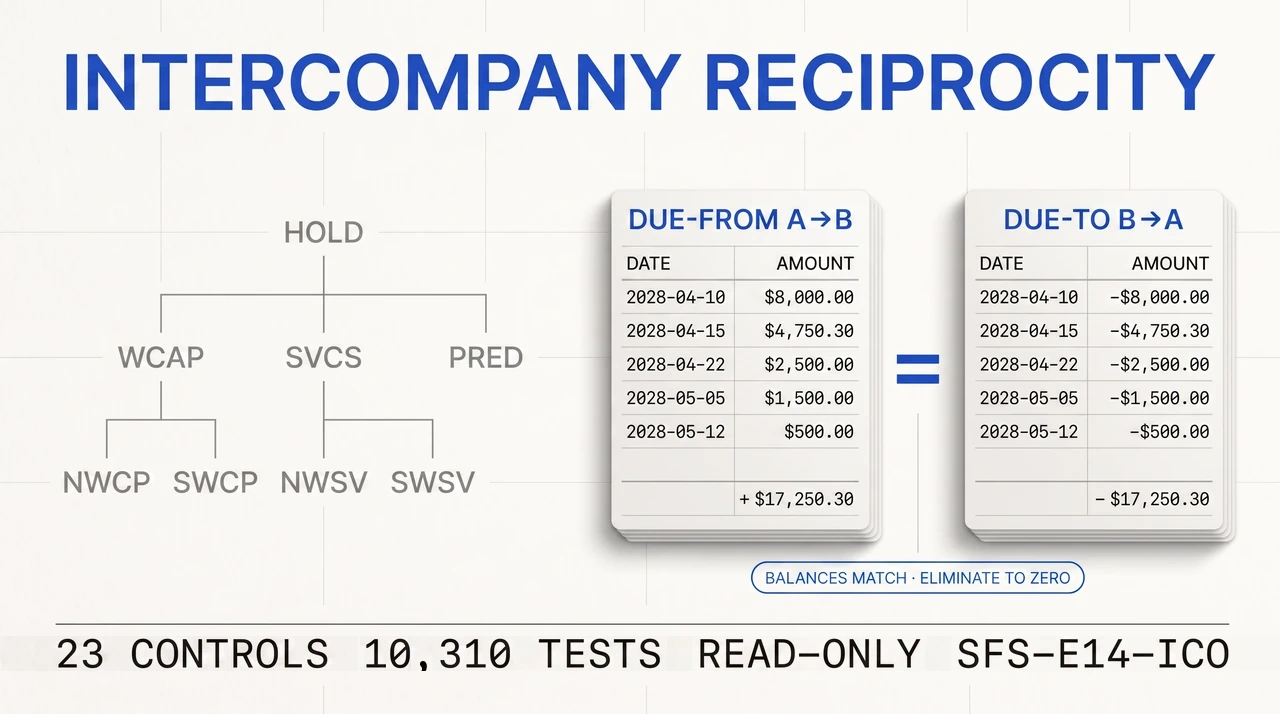
A development group is a tree of entities, not one company: a holding parent over a services arm that carries the payroll and a capital arm that guarantees the construction loans, plus a predevelopment entity that carries land while it is entitled. Cash moves between them constantly, and every move lands two entries on two sets of books kept by two people. This engine reads the artifacts the consolidation process emits and runs twenty-three deterministic controls over them: is the entity tree itself sound, does every due-from equal the due-to that faces it, does each closing balance roll forward from the transactions that moved it, does the cash come from the protocol-correct entity and flow down the ownership chain, and does the guarantor meet its liquidity covenant. It never funds, never sweeps and never writes to a source artifact.
The failure mode here lives between two entities, never inside one. Each company's own books foot; the break only surfaces at consolidation, when the intercompany balances are supposed to eliminate to zero and instead leave a residual nobody can source. By then the period is closed. A one-sided balance, a closing that quietly stopped tying to the ledger, an advance funded from the wrong arm of the group -- none of these move a single entity out of balance, which is exactly why a person closing one set of books cannot see them. The engine ships a planted-defect file for every registered control, so the benchmark is a command rather than a claim.
Seven control families run in registry order over each period file. The first proves the others had something to read, and that every code they resolve exists.
A development group runs as a tree of legal entities, and cash never stops moving between them: advances down the chain to fund predevelopment and overhead, repayments back up out of land sales, equity into projects. Each of those movements is booked twice, on two sets of books, by two people. The arithmetic on each set of books foots perfectly. Nothing inside any one company is out of balance. The break, when there is one, exists only in the space between two entities -- a due-from that one side carries larger than the due-to the other acknowledges, a closing balance that quietly stopped tying to the transactions that moved it, an advance funded from the capital arm when the protocol says it must come from the top parent. None of these move a single entity out of balance, so a person closing one company cannot see them; they surface only at consolidation, when the intercompany balances are supposed to eliminate to zero and instead leave a residual nobody can source, after the period is closed. These are not judgment calls. They are equalities: a due-from against a due-to, a closing against a roll-forward, a funding source against a rule -- which is what a deterministic control settles better than a controller reconciling one entity at a time.
The seeded demo runs every control over every period file7. The CLI generates 25 fictional period files -- one clean baseline and one carrying each planted defect -- then runs all 23 controls over each. The clean file returns PASS with no flags; every defect file returns REVIEW or FAIL and names the control it tripped along with the reason that control exists.
A drift of one cent between the two sides8. A test moves a single due-to closing by one cent. The reciprocity control fires, and the pair-symmetry and roll-forward controls stay silent -- the balance is still two-sided and still ties to its own ledger, which is exactly why the drift is invisible on either entity alone and only a check spanning both finds it.
The group eliminates to zero9. A test sums every due-from closing and every due-to closing on the clean baseline and asserts the two totals are equal -- the property that makes the intercompany balances cancel on consolidation. It holds because every pair is reciprocal, which is the thing the registry is built to keep true.
| Command | Operation | Output | Exit | Artifacts |
|---|---|---|---|---|
python run.py | generate the seeded fictional corpus, run all twenty-three controls, write both reports | per-file verdicts and every actionable finding, then the overall verdict | 2 for the bundled corpus, which carries a planted defect for every control by design | intercompany_report.md, intercompany_report.json, samples/ |
python -m intercompany_engine samples | analyze an existing folder of period files without regenerating it | per-file verdicts and findings | 0 PASS / 1 REVIEW / 2 FAIL / 3 usage | none unless --json or --md is passed |
python -m intercompany_engine samples --generate --quiet | regenerate the corpus and print only the overall verdict | a single verdict line | 0 PASS / 1 REVIEW / 2 FAIL / 3 usage | samples/ |
python -m pytest | run the full test suite for this engine | 10310 passed | 0 when every test passes | none |
| Measure | Result |
|---|---|
| Engine tests10 | 10,310 tests collected live collection from the engine directory |
| Registered controls11 | 23 controls counted from the registry, not from documentation |
| Planted defects12 | 24 defect files every registered control has at least one file that trips it |
| Control coverage13 | 100 percent of controls with a planted defect no control ships without a file demonstrating it firing |
The engine has no write path and therefore no autonomy to gate. It produces findings; a person decides.
Deterministic envelope. seeded fictional inputs, read-only operation, offline default mode.
Demo gate. FAIL on the bundled corpus, by design -- it carries a planted defect for every registered control
| Severity | Verdict | Action |
|---|---|---|
| No findings above PASS | PASS | carry the mechanically clean positions into the documented consolidation review |
| One or more FLAG, no FAIL | REVIEW | a human resolves each flag; an advance running up the chain, a cash target out of band, and a large advance awaiting a second signature all land here |
| One or more FAIL | FAIL | the positions do not go to consolidation until the failing control is cleared |
Distribution: public repository, MIT license.
One conversation: you describe the work that consumes your team's month; we tell you plainly what this engine can take over, what it can't, and what a scoped first phase would cost. Your people keep approval authority.
Book a free consultation