$50.00 (default)1
Materiality threshold
differences at or under $50 are timing noise; above becomes a numbered flag
ENGINE 02
SFS-E02-RCN · RECONCILIATION · REV 2026-07-20 · PRODUCTION
PRODUCTION = runnable end-to-end, CI-backed, full test suite passing. All data fictional and seeded.
Deterministic cash & debt reconciliation, keyed by account number, materiality-gated.
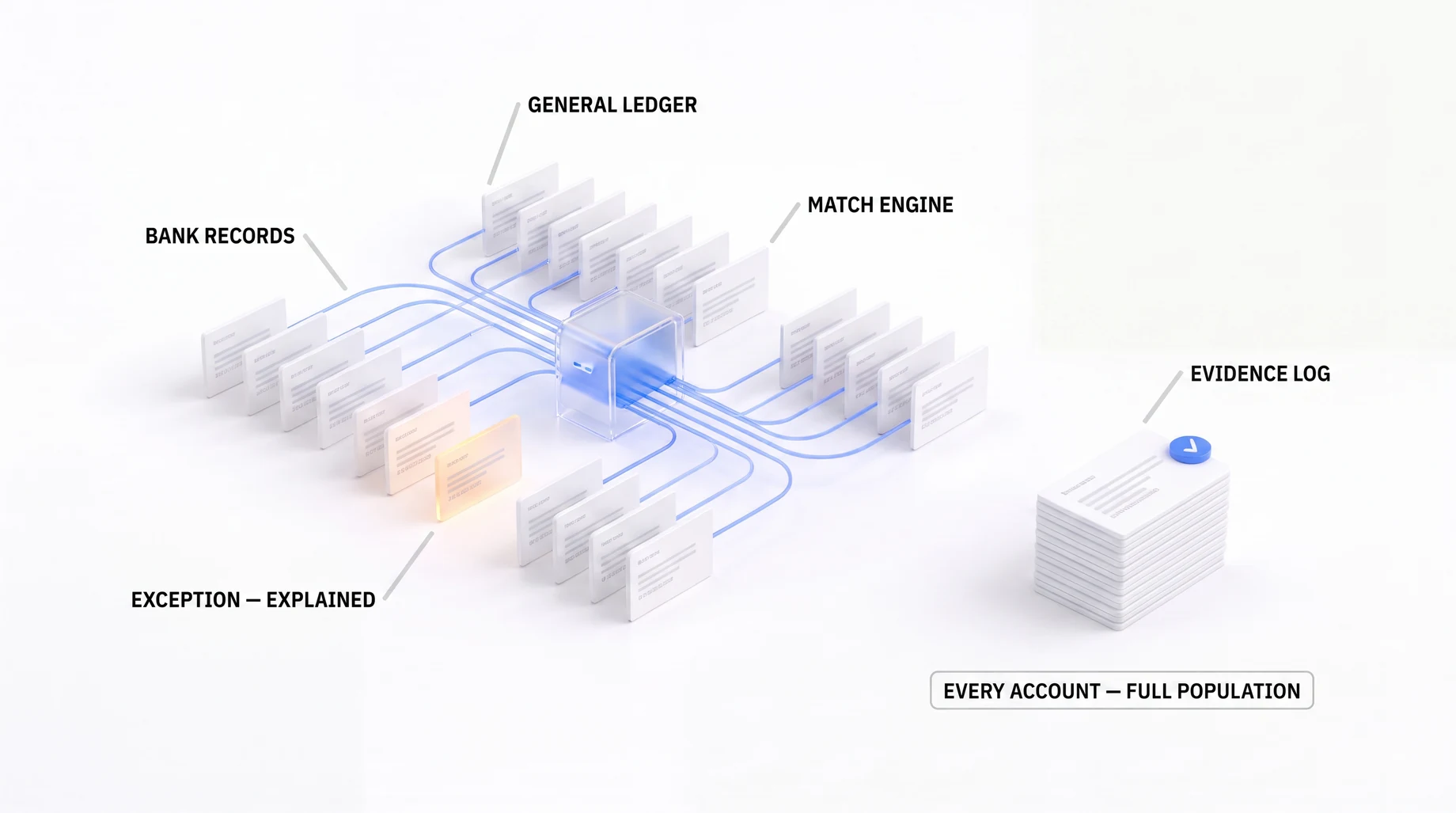
The engine ties each entity's GL cash to the bank ending balance and each GL loan to a 3-part lender total (principal + interest/reserve + late paydown), matching by account number so a figure never lands on the wrong row. Differences at or under a $50 materiality threshold are logged as timing noise; anything larger becomes a numbered flag for review. Every run emits the same 5-section evidence log — a Markdown file and a color-coded Excel workbook. An optional assurance loop restores a drifted package back to the seeded source of record and applies a materiality gate before it ships.
A reconciliation is only as trustworthy as the evidence trail behind it. Every figure on this page re-derives from the public repository — the demo is a command you run, not a claim you take on faith.
Each layer is an independent stage, from the seeded substrate up to the optional assurance loop. Select a layer for its plain-terms and engineering detail.
Reconciling cash and debt means tying every bank and lender movement to the general ledger, explaining the differences, and keeping audit-ready evidence across many entities. Performed by hand the work is repetitive and slow, and the evidence trail comes out inconsistent from month to month. This engine automates the tie-out on a repeatable cadence, builds materiality and escalation into the process so reviewers see signal instead of noise, and produces a consistent, audit-ready evidence log every cycle.
March 2026 base reconciliation7. python -m recon_engine reconciles the seeded March-2026 books: 9 accounts (4 cash, 4 debt, 1 dormant skipped) resolve to 5 clean, 1 timing, 2 flagged. FLAG-001 CASH-1001 (Maple Fund LP) is a -1,875.40 deposit-in-transit; FLAG-002 DEBT-2003 (Cedar Ridge Partners LLC) is a +12,500.00 keying error. The process exits 0.
The 3-part debt formula ties out8. The debt section proves the optional third leg is wired through. DEBT-2000 (Demo Holdings LLC) carries a 7,500.00 late-paydown mirrored GL-to-lender and still ties clean at 0.00; DEBT-2002 (Birchwood Op Co) shows an 18.75 interest accrual booked in GL but not yet on the lender statement, which is under $50 and therefore a yellow timing item, not a flag.
The assurance loop restores a drifted package9. python -m recon_engine.loop --demo injects three faults on baseline-clean accounts: CASH-1002 GL fat-fingered +4,830.25, DEBT-2000 lender statement dropped, DEBT-2001 mis-marked dormant. The loop resyncs those three accounts in three turns (budget 11), driving deviations from 3 to 0. Gross corrective movement of 4,831.25 exceeds the $50 materiality, so the verdict is FLAG with exit 0, and the scenario's genuine flags are left untouched.
| Command | Operation | Output | Exit | Artifacts |
|---|---|---|---|---|
python -m recon_engine | generate synthetic data, reconcile, write both logs | console summary: period, seed, materiality, in-scope counts, clean/timing/flagged, and the flagged list | 0 | evidence-log.md (committed), output/evidence-log.xlsx (gitignored) |
python run.py | convenience alias for python -m recon_engine (same args) | same console summary | 0 | evidence-log.md, output/evidence-log.xlsx |
python -m recon_engine --threshold 25 | tighten materiality to $25 | borderline variances reclassify between timing and flag | 0 | evidence-log.md (+ xlsx) |
python -m recon_engine --seed 7 | regenerate synthetic data with a different seed | a new byte-deterministic dataset and log | 0 | evidence-log.md (+ xlsx) |
python -m recon_engine --no-xlsx | Markdown only; skip the workbook | console summary without the XLSX line | 0 | evidence-log.md |
python -m recon_engine.loop --demo | inject the drift profile and run the assurance loop | turn-by-turn Markdown; verdict PASS/FLAG/FAIL with gross movement vs materiality | 0 (PASS/FLAG) or 1 (FAIL) | assurance_loop_report.md when --out DIR is given; otherwise stdout only |
python -m pytest -q | run the default test suite (the SWEEP-gated bulk grid is excluded) | pass/fail summary over 7,511 collected tests | 0 on pass | none (.pytest_cache only) |
| Measure | Result |
|---|---|
| Tests collected10 | 7,511 tests (default) an exhaustive bulk invariant grid raises this to 162,479 with SWEEP=1 |
| Seeded reconciliation11 | 9 accounts (8 active + 1 skipped; 2 flagged) 5 clean, 1 timing, 2 flagged in the March-2026 seed |
| Loop convergence12 | 3 -> 0 deviations in 3 turns / budget 11 restores three injected faults to the source of record |
| Loop gross correction13 | 4,831.25 USD across 3 booked corrections material, so the verdict is FLAG (converged, exit 0) rather than PASS |
The base engine always exits 0 — a flag is an expected reconciliation outcome, not a program failure. The assurance loop adds an automated materiality gate: PASS and FLAG both exit 0 (FLAG surfaces material corrections so a reviewer sees what moved before the package ships), while FAIL exits 1 only on non-convergence. The gate labels and routes the output; it does not stand in for a human sign-off.
Deterministic envelope. seeded fictional inputs, offline default mode.
Demo gate. automated-materiality-gate
| Severity | Verdict | Action |
|---|---|---|
| |variance| <= $0.005 (tie tolerance) | clean (green) | note 'ties to source'; no action |
| $0.005 < |variance| <= threshold ($50) | timing (yellow) | comment as timing/noise, expected to clear; not escalated |
| |variance| > threshold | flag (red, FLAG-###) | assign a sequential flag id; escalate for review |
| dormant / zero-activity account | skipped (grey) | skip with a documented note; no reconciliation required |
| loop: converged, total corrections <= materiality | PASS | clean to file; exit 0 |
| loop: converged, total corrections > materiality | FLAG | ship with a note of what moved; exit 0 |
| loop: not converged within the turn budget | FAIL | escalate; exit 1 |
Distribution: public repository, MIT license.
One conversation: you describe the work that consumes your team's month; we tell you plainly what this engine can take over, what it can't, and what a scoped first phase would cost. Your people keep approval authority.
Book a free consultation