10,3551
Tests
the collected checks that pin this engine's behavior
ENGINE 42
SFS-E42-USM · SALES ADMINISTRATION · REV 2026-07-24 · PRODUCTION
PRODUCTION = runnable end-to-end, CI-backed, full test suite passing. All data fictional and seeded.
Does the Matrix still tie to the tabs that feed it?
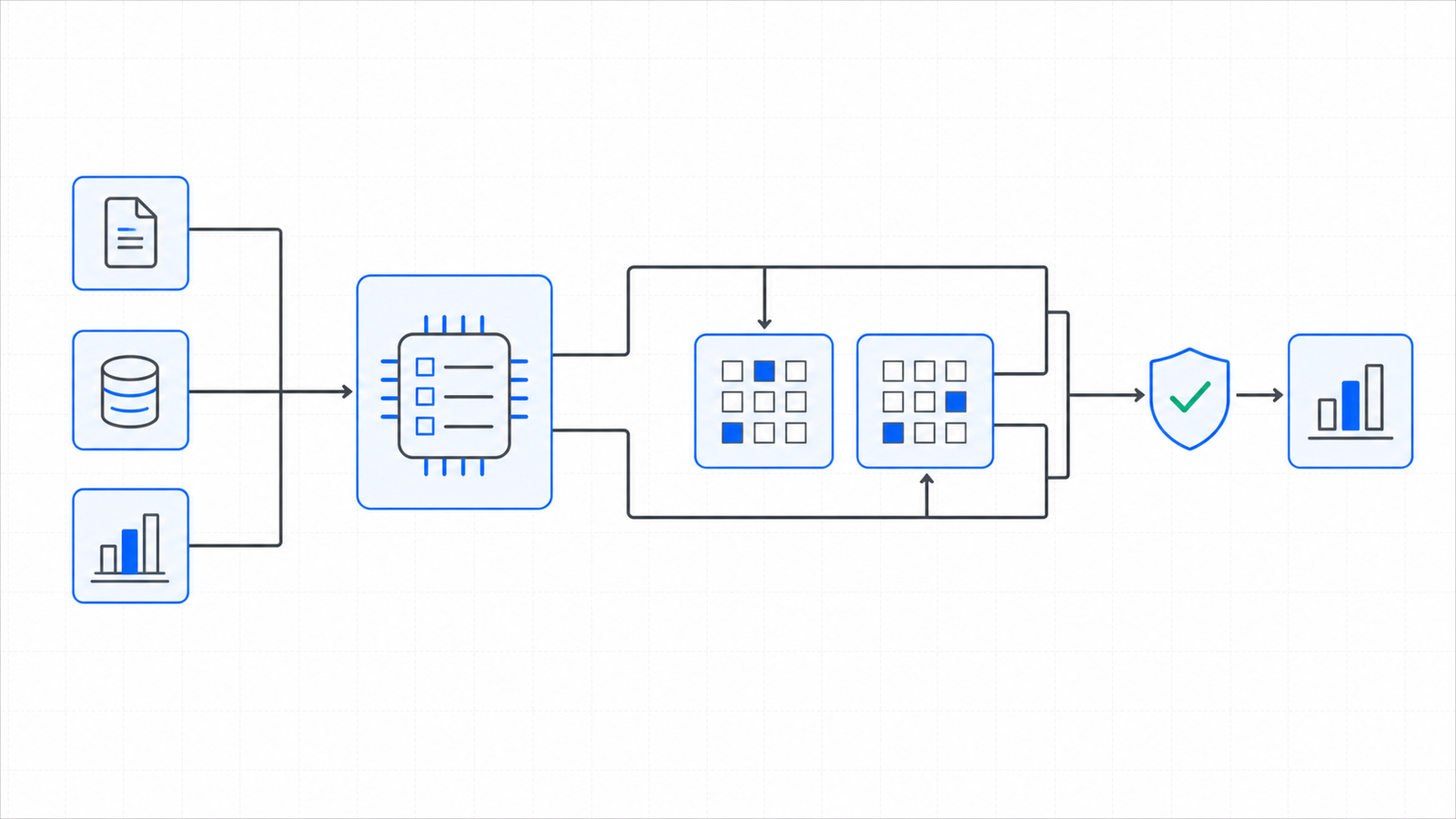
A residential for-sale project is administered out of one workbook, instantiated from the same template on every project, and that workbook has to prove itself row by row. The Matrix tab carries every unit -- plan, plan square footage, list price, sales price, concession, revenue per square foot, closing costs and total selling commission. The Sold/Close tab logs the offer date, the actual date sold, the closing date and whether proof of closing came back. The Commission Log splits each unit's total commission across the named selling agents who earned it. This engine reads the seven artifacts that record emits -- the plan register, the Matrix, the commission schedule, the Sold/Close log, the agent register, the Commission Log and the sales rollup -- and runs twenty-one deterministic controls over them. Is the file complete and the review date readable, are the plan codes unique and every plan area a positive whole count, is every Matrix row complete, uniquely identified, on a declared plan and in a known status, does revenue per square foot re-derive as the sales price over the plan area, does net proceeds re-derive as price less concession less closing costs, does the concession sit inside the price it discounts, was the discount to list inside the sales office's own band, is the unit's sale channel priced on the commission schedule, does the total commission re-derive as the channel rate on the sales price, do the Commission-Log splits sum to exactly the total the Matrix authorised, is every payee in the agent register, do the sold units reconcile one-to-one to the Sold/Close tab in offer-sale-closing order with proof on file, and do the rollup's sold count, revenue totals and commission total recompute from the Matrix beneath them. Every derived figure is compared with exact == in integer cents, truncation is the contract in both directions so a floored derivation can be compared to a stated figure without a tolerance band, every closing test is measured to the review date the file carries rather than the system clock, and no source artifact is ever written.
The Matrix foots, which is exactly why nobody re-adds it. A derived column is a formula until somebody types over one cell of it for one unit, and from that moment the column is a mixture of computed and typed figures that no longer follows from the prices beside it -- and the mixture is invisible on a printed tab. The Commission Log keeps paying a total the Matrix no longer authorises: a split edited after the fact, or an agent added without reducing another, pays an amount no row approved, and because one template is instantiated on every project the same cent recurs on every unit it produced. And the tabs quietly stop reconciling -- a unit marked sold that never reaches the Sold/Close tab, a closing logged with the sale date before the offer that produced it, a rollup that leaves the sales office carrying a count the Matrix does not support. None of those look wrong on the tab. The engine rebuilds every derived figure -- revenue per square foot, net proceeds, total commission, each agent's split in cents and all three rollup totals -- from the base prices through the same tie-out kernel that produced the data, compares with exact == in integer cents, reconciles the Sold/Close tab in both directions, ships a planted-defect file for every registered control, and states its benchmark as a command rather than a claim.
Seven control families run in registry order over each sales file. The first proves the others had something to read and that the review date is legible, because a control that passes on absent evidence reports assurance it never performed.
A residential for-sale project -- condo or townhome -- is administered out of one workbook, instantiated from the same template on every project, and the same three failures recur in each instantiation. The Matrix tab carries every unit: plan, plan square footage, list price, sales price, concession, revenue per square foot, closing costs and total selling commission. The Sold/Close tab logs the offer date, the actual date sold, the closing date and whether proof of closing came back. The Commission Log splits each unit's total commission across the named selling agents who earned it. First, a derived column stops deriving: revenue per square foot, net proceeds and total commission are formulas until somebody types over one of them for a single unit, and from then on the column is a mixture of computed and typed figures that no longer follows from the prices beside it -- and the mixture is invisible on a printed tab. Second, the commission splits stop adding up: the log pays named agents, the sum of the splits on a unit is meant to be the total the Matrix authorised, and a split edited after the fact or an agent added without reducing another leaves the log paying an amount no row ever approved. Third, the tabs stop reconciling: a unit is marked sold and never reaches the Sold/Close tab, a closing is logged with the sale date before the offer date, or the rollup that leaves the sales office states a count and a revenue total the Matrix does not support. None of these are judgment calls. They are equalities and comparisons -- a stated figure against its re-derivation with exact == in integer cents, a set of splits against the total it divides, a set of sold ids against a set of closing ids in both directions, three dates against each other with <= -- which a deterministic control settles better than a workbook inherited by whoever administers sales this quarter.
The seeded demo runs every control over every sales file7. The CLI generates twenty-three fictional sales files -- one clean baseline and one carrying each of the twenty-two planted defects -- then runs all twenty-one controls over each. The clean file returns PASS with no flags; every defect file returns REVIEW or FAIL and names the control it tripped along with the reason that control exists.
The splits are compared against the row that authorised them8. A defect file shortens one agent's split on UNIT-105 by a hundred dollars and leaves every other figure untouched, so the Commission Log still looks internally orderly and the Matrix still foots. comm_splits_tie sums the three logged splits on the unit, compares them in integer cents with exact == to the total commission the Matrix row authorised, and reports the shortfall against the row that approved it.
The Sold/Close reconciliation runs both ways9. One defect file deletes the closing row for UNIT-104 while the Matrix still marks it sold, and close_sold_reconciles reports revenue the Matrix claims that the tab cannot evidence. The same control tests the other direction on every file -- a closing row for a unit the Matrix does not call sold -- which is the harder break to notice and the one that leaves a settled sale out of the period.
| Command | Operation | Output | Exit | Artifacts |
|---|---|---|---|---|
python run.py | regenerate the seeded fictional corpus, run all twenty-one controls, write both reports | per-file verdicts and every actionable finding, then the overall verdict | 2 for the bundled corpus, which carries a planted defect for every control by design | sales_report.json, sales_report.md, samples/ |
python -m sales_engine samples | analyze an existing folder of sales files without regenerating it | per-file verdicts and findings | 0 PASS / 1 REVIEW / 2 FAIL / 3 usage | none unless --json or --md is passed |
python -m sales_engine samples --generate --quiet | regenerate the corpus and print only the overall verdict | a single verdict line | 0 PASS / 1 REVIEW / 2 FAIL / 3 usage | samples/ |
python -m pytest sales_engine/tests -q | run the full test suite for this engine | 10355 passed | 0 when every test passes | none |
| Measure | Result |
|---|---|
| Engine tests10 | 10,355 tests collected live collection from the engine directory |
| Registered controls11 | 21 controls counted from the registry, not from documentation |
| Planted defects12 | 22 defect files every registered control has at least one file that trips it |
| Control coverage13 | 100 percent of controls with a planted defect no control ships without a file demonstrating it firing |
The engine has no write path and therefore no autonomy to gate. It produces findings; a person decides whether a commission is released, a closing is chased and a rollup is sent.
Deterministic envelope. seeded fictional inputs, read-only operation, offline default mode.
Demo gate. FAIL on the bundled corpus, by design -- it carries a planted defect for every registered control
| Severity | Verdict | Action |
|---|---|---|
| No findings above PASS | PASS | carry the mechanically clean sales file into the documented sales-administration review and sign-off |
| One or more FLAG, no FAIL | REVIEW | a human resolves each flag; a sold unit discounted past the approved band and a due closing whose proof has not come back both land here |
| One or more FAIL | FAIL | the figure is not carried into the rollup or the commission run until the failing control is cleared -- a derived column that does not recompute, a split that does not tie, an unreconciled closing, a date sequence that runs backwards, or a rollup total that does not foot |
Distribution: public repository, MIT license.
One conversation: you describe the work that consumes your team's month; we tell you plainly what this engine can take over, what it can't, and what a scoped first phase would cost. Your people keep approval authority.
Book a free consultation