ENGINE 04

SFS-E04-VAL · READ-ONLY VALIDATION · REV 2026-07-20 · PRODUCTION

PRODUCTION = runnable end-to-end, CI-backed, full test suite passing. All data fictional and seeded.

Validation Engine

A read-only rules engine that flags workbook defects human review misses — and can never introduce one.

The Validation Engine opens a finished Excel workbook read-only and runs six independent checks over it: whether the closing-surplus total is formula-driven rather than typed over, whether the trial balance ties out, whether stale review notes were left behind, whether the audit lineage flows inputs to formulas, whether draft-only MIN/MAX cap logic was ever replaced, and whether the sibling JSON export still agrees with the workbook. Each check yields a PASS, FAIL, or FLAG finding with a Sheet!Cell location, and the findings roll up to one verdict — PASS, REVIEW, or FAIL — plus a matching process exit code. It ships with a seeded synthetic generator so it runs end-to-end on fully fictional data, and it never writes to the file it audits.

Every count on this page is a command, not a claim. The six checks, the seven-workbook demo corpus, and the pinned test total each re-derive from the public repository.

Run it Book a consultation

Architecture

functional block stack · static overview
Verdict & Reporting Registry Runner Rule Registry (6 checks) Workbook Context (dual read-only load) Seeded Synthetic Corpus substrate: seeded fictional data

Select a layer

Each layer is an independent stage of the read-only pipeline. Select a layer for its plain-terms and engineering detail.

Key specifications

at a glance
4,8141
Tests
the checks that pin this engine's behavior
62
Rules in registry
six independent checks run over every workbook
PASS / REVIEW / FAIL3
Verdict states
the worst finding wins the workbook
0 / 1 / 2 / 34
Exit codes
PASS 0, REVIEW 1, FAIL 2, usage error 3
2 (read-only)5
Read passes / workbook
opened twice read-only — formulas and cached values — never written
7 workbooks6
Demo corpus
one clean plus one per rule, each with a single planted defect

What it does for you

plain terms

Large, formula-heavy financial workbooks must be checked before sign-off, and the errors that survive human review are the subtle ones: a total hardcoded on top of its formula, a trial balance off by a plug, a leftover 'reviewer decision' note, inverted lineage where an evidence input holds a formula, a draft MIN/MAX cap that was never removed, or a published JSON that no longer matches the workbook it came from. Checking these by eye across many near-identical workbooks is slow and error-prone, and asking an LLM 'did you fix everything?' returns a confident 'yes' whether or not it is true. This engine replaces that with a deterministic, read-only registry of checks that runs identically every time and cannot alter the audited file.

A hardcoded total slips past review7. Maple Fund LP's closing surplus was typed in as the literal 900 instead of the formula =B3+B4+B5. expected_formula fires FAIL at Surplus-Detail!B6 ('expected a formula but found hardcoded value: 900'), lineage_direction adds a FLAG on the same cell, and the workbook verdict is FAIL.

A trial balance off by a plug8. Birchwood Op Co's trial balance no longer ties out. debit_credit_balance sums the columns and reports FAIL at Trial-Balance!B:C ('debit=885 vs credit=875, diff=10'), driving the workbook to FAIL.

A published JSON disagrees with the workbook9. Demo Holdings LLC's sibling JSON export carries closing_surplus=1725 while the workbook resolves to 1700. json_tieout fires FAIL at json:closing_surplus, catching a published figure that drifted from its source.

Functional block diagram

engineering · each block links to its source
Functional block diagram of the Validation Engine engine samples + JSON context findings verdict + exit code Seeded generator Dual read-only load expected_formula debit_credit_balance forbidden_text lineage_direction cap_logic_leftover json_tieout Verdict roll-up Reports + exit code SFS-E04-VAL · FUNCTIONAL BLOCK DIAGRAM · REV 2026-07-20

Plain terms

  • Seeded generator. Writes fictional workbooks and JSON exports to ./samples — one clean and one per planted defect.
  • Dual read-only load. Opens each workbook twice read-only (formulas and cached values) and attaches the sibling JSON export.
  • expected_formula. Checks that cells which should be formula-driven hold a formula, not a typed-in number.
  • debit_credit_balance. Sums the trial-balance debit and credit columns and confirms they tie out.
  • forbidden_text. Scans every cell for stale review notes and internal / tool words (TODO, 'reviewer decision', tool names).
  • lineage_direction. Confirms evidence cells are raw inputs (literals) and detail drivers are formulas; either inversion flags.
  • cap_logic_leftover. Detects leftover draft MIN/MAX cap logic that should have been replaced before final.
  • json_tieout. Cross-checks the sibling JSON export's closing_surplus against the workbook's resolved value.
  • Verdict roll-up. Collapses all findings for a workbook, and then the whole run, into one verdict — worst wins.
  • Reports + exit code. Emits the markdown and JSON reports and returns an exit code encoding the verdict.

Engineering

  • Seeded generator. generate.generate_corpus(out_dir, seed=20240614); wipes stale *.xlsx / *.json first, then writes the clean plus six defect workbooks with sibling .json.
  • Dual read-only load. engine._load_context(): load_workbook(read_only=True) twice (data_only False / True) plus json.loads(<stem>.json), wrapped in WorkbookContext.
  • expected_formula. check_expected_formula() over EXPECTED_FORMULA_CELLS; a literal is a FAIL.
  • debit_credit_balance. check_debit_credit_balance() sums TB_DEBIT_COL / TB_CREDIT_COL from cached values; |diff| >= 1e-6 is a FAIL.
  • forbidden_text. check_forbidden_text() substring-matches FORBIDDEN_TEXT over iter_formula_cells(); a hit is a FLAG.
  • lineage_direction. check_lineage_direction() over EVIDENCE_INPUT_CELLS and DETAIL_DRIVER_CELLS; an inversion is a FLAG.
  • cap_logic_leftover. check_cap_logic_leftover() applies a case-insensitive MIN/MAX open-paren regex over formula cells; a match is a FLAG.
  • json_tieout. check_json_tieout() compares json_data['closing_surplus'] to _closing_surplus_value(); a mismatch is a FAIL, an unresolvable value a FLAG.
  • Verdict roll-up. WorkbookReport.verdict (any FAIL -> FAIL, else any FLAG -> REVIEW, else PASS), then overall_verdict() over all reports.
  • Reports + exit code. build_markdown_report() / build_json_report() write the files; cli.main() returns _EXIT_BY_VERDICT[overall] (0 / 1 / 2), or 3 on a usage error.

Instruction set

every public command
CommandOperationOutputExitArtifacts
python run.py
zero-arg quickstart: regenerate the fictional corpus into ./samples, validate it, and write both reportsgeneration line, per-workbook findings, 'Overall verdict: FAIL (7 workbook(s))'0 / 1 / 2 by verdictsamples/*.xlsx + .json, validation_report.json, validation_report.md
python -m validation_engine ./samples
validate every .xlsx in a folder (read-only) and print findings'=== <wb> === verdict: ...' blocks + overall verdict line0 PASS / 1 REVIEW / 2 FAIL / 3 usagenone (stdout only)
python -m validation_engine.generate
write the seeded fictional workbooks + JSON exports into ./samples'Wrote 7 fictional workbook(s) to <samples>' + names0samples/*.xlsx, samples/*.json
python -m validation_engine ./samples --generate --json report.json --md report.md
(re)generate the corpus, validate, and write the structured JSON + markdown reportsgeneration line + findings + 'Wrote JSON/markdown report'0 / 1 / 2 by verdictreport.json, report.md
python -m pytest -q
run the test suite (defects caught, clean passes, report shape, read-only, determinism)pytest summary line0 on passnone

Benchmarks

measured demo results
MeasureResult
Demo workbooks validated107 workbooks
the committed example run validates seven workbooks and returns overall FAIL
Planted defects caught116 of 6 defects, one per rule
one defect per rule is planted and each is caught by its own rule; the clean workbook passes
Rules in registry126 checks
six checks run over every workbook, each with a fixed severity
Engine tests134,814 tests

Control characteristics

engineering

Plain terms

The engine only reports; it never writes to, approves, or signs off the audited file. The PASS / REVIEW / FAIL verdict and its exit code (0 / 1 / 2, or 3 for a usage error) are the handoff a human reviewer or CI pipeline consumes to decide whether to proceed.

Engineering

Deterministic envelope. seeded fictional inputs, read-only operation, offline default mode.

SeverityVerdictAction
Any FAIL finding (expected_formula, debit_credit_balance, or a json_tieout mismatch)FAILexit code 2 — a hard defect is present; block sign-off
One or more FLAG findings and no FAIL (forbidden_text, lineage_direction, cap_logic_leftover, or an unresolvable json_tieout)REVIEWexit code 1 — human review before sign-off
Every finding PASSPASSexit code 0 — clean

Operating limits

what it refuses to do

See it run

animated overview
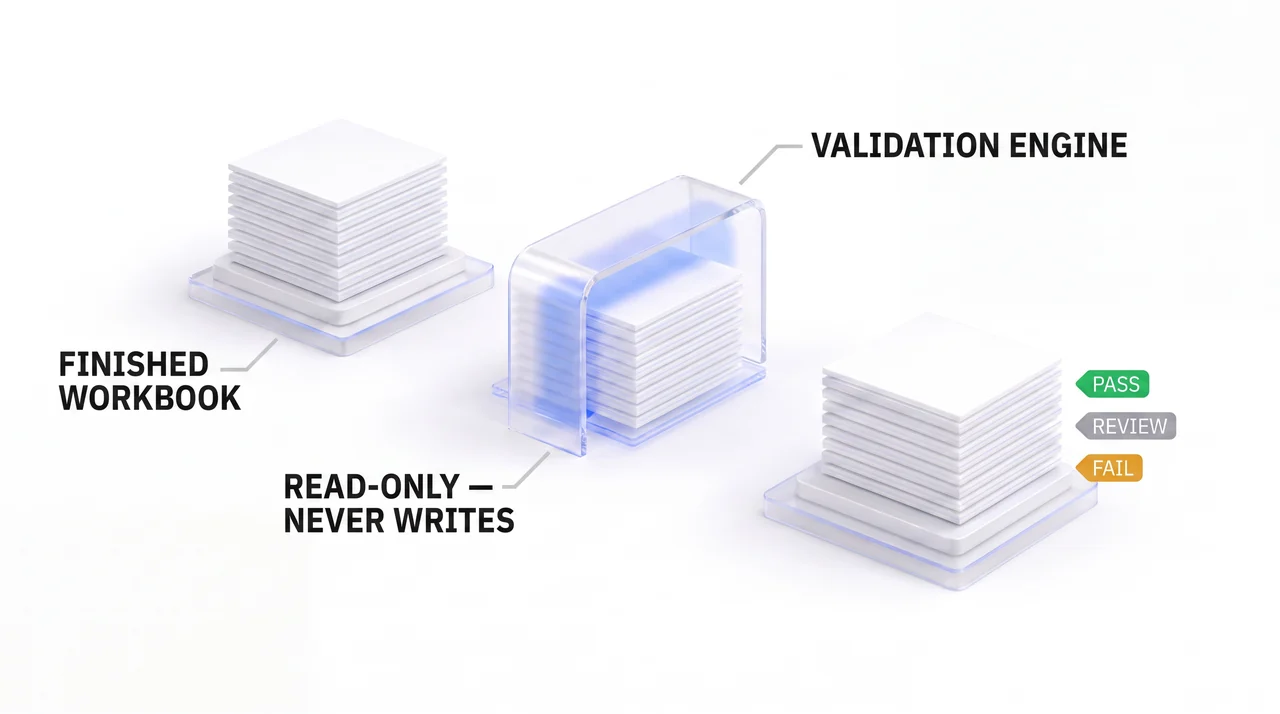
Isometric brand animation: a stack of sheets labeled 'Finished workbook' at left; a translucent glass bracket labeled 'Validation Engine — read-only, never writes' passing over a workbook at center with a blue scan glow; and an output stack at right tagged with three verdict chips — PASS (green), REVIEW (grey), FAIL (amber).
Animated overview of the read-only validation pass on fictional seeded data; run the commands above to reproduce.

Integration

how to run it

Distribution: public repository, MIT license.

git clone https://github.com/sophonfinance-wq/finance-automation-portfolio.git && cd finance-automation-portfolio/audit-automation && python run.py
python -m validation_engine ./samples
Source on GitHub Engine README All tests, by engine Run in Codespaces
Substantiation
  • 1python -m pytest --collect-only -q (audit-automation/); verified 2026-07-20 and pinned in site-datasheets/counts.json
  • 2audit-automation/validation_engine/engine.py — REGISTRY; README rule table
  • 3audit-automation/validation_engine/engine.py — Verdict enum
  • 4audit-automation/validation_engine/cli.py — _EXIT_BY_VERDICT and docstring
  • 5audit-automation/validation_engine/engine.py — _load_context
  • 6audit-automation/validation_report.json — workbook_count; generate.py DEFECTS
  • 7audit-automation/README.md — committed example output
  • 8audit-automation/README.md — committed example output
  • 9audit-automation/README.md — committed example output
  • 10audit-automation/validation_report.json — workbook_count: 7, overall_verdict: FAIL
  • 11audit-automation/validation_engine/generate.py — DEFECTS; README example output
  • 12audit-automation/validation_engine/engine.py — REGISTRY; validation_report.json registry array
  • 13python -m pytest --collect-only -q (audit-automation/); verified 2026-07-20 and pinned in site-datasheets/counts.json
  • 14audit-automation/validation_engine/engine.py — _load_context load_workbook(read_only=True); README
  • 15audit-automation/validation_engine/engine.py — check_json_tieout
  • 16audit-automation/validation_engine/engine.py — sheet-presence guards in each check

Show us where the hours go.

One conversation: you describe the work that consumes your team's month; we tell you plainly what this engine can take over, what it can't, and what a scoped first phase would cost. Your people keep approval authority.

Book a free consultation