10,2991
Tests
the collected checks that pin this engine's behavior
ENGINE 13
SFS-E13-WRC · INSURANCE CLAIMS · REV 2026-07-22 · PRODUCTION
PRODUCTION = runnable end-to-end, CI-backed, full test suite passing. All data fictional and seeded.
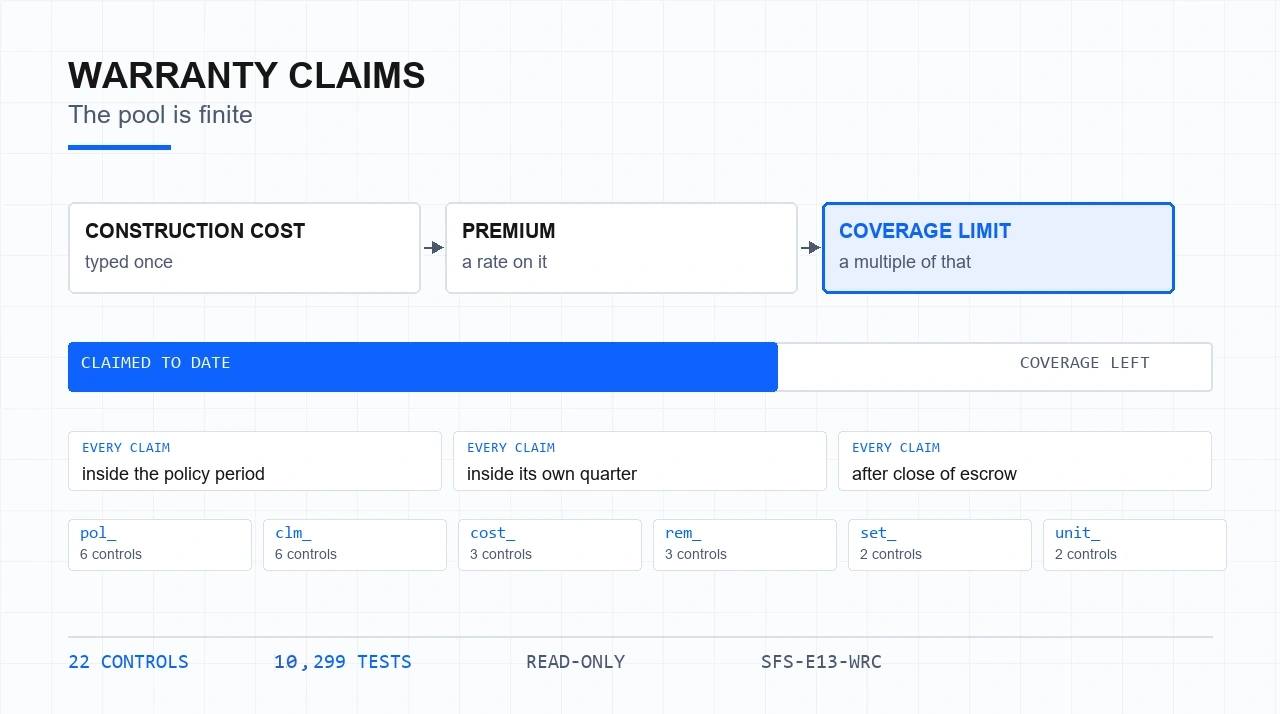
The pool is finite
A builder buys a warranty policy at the start of a project, then spends years claiming against it a few thousand dollars at a time. Each claim is trivially small; the policy behind them is not, and it is finite. This engine reads the artifacts the programme emits and runs twenty-two deterministic controls over them: are the policy terms internally consistent and is the pool intact, does each claim sit inside its policy period and its own quarterly window, is there a real warranty cost behind every claimed dollar, did the unit close before the defect, and is the money going to the insured entity. It never files, never pays and never writes to a source artifact.
The failure mode here is accumulation. Any one claim is obviously fine, and nobody reviewing a single claim can see the running total or the boundary it is about to cross. A quarter still foots with an uncovered claim inside it. The engine ships one planted defect per registered control, so the benchmark is a command rather than a claim.
Six control families run in registry order over each claim file. The first proves the others had something to read.
A warranty policy is bought once and drawn down for years in amounts too small to attract review. That combination is what makes the programme go wrong. The pool is finite, but no individual claim is anywhere near the limit, so the running total is the only place the breach is visible and nothing in a claim form shows it. The coverage limit itself descends from two derivations nobody re-examines after the policy is bound, so an error at inception rescales everything measured against it afterwards. And every claim sits at three boundaries at once -- its quarter, the policy period, and the close of escrow of the home it belongs to -- of which only the first is obvious from the document being reviewed. A claim dated outside the policy still lets its quarter foot perfectly. A defect claimed before the home was sold looks identical to one claimed after. These are not judgment calls; they are date comparisons and a running sum, which is what a deterministic control does better than a reviewer approving a $640 cabinet repair.
The seeded demo runs every control over every claim file7. The CLI generates 25 fictional claim files -- one clean baseline and one carrying each planted defect -- then runs all 22 controls over each. The clean file returns PASS with no flags; every defect file returns REVIEW or FAIL and names the control it tripped along with the reason that control exists.
A claim inside its quarter, outside the policy8. A test dates a claim one day past the policy end while leaving its quarterly window wide enough to contain it. The policy-period control fires and the quarterly subtotal control stays silent -- demonstrating why the two checks are deliberately separate rather than merged.
The pool is exact at its boundary9. Cumulative reimbursement equal to the coverage limit to the cent passes; one cent more fails. A companion test asserts the exhausted pool is flagged for review rather than failed, because spending it precisely is valid and somebody still needs to know.
| Command | Operation | Output | Exit | Artifacts |
|---|---|---|---|---|
python run.py | generate the seeded fictional corpus, run all twenty-two controls, write both reports | per-file verdicts and every actionable finding, then the overall verdict | 2 for the bundled corpus, which carries one planted defect per control by design | warranty_report.md, warranty_report.json, samples/ |
python -m warranty_engine samples | analyze an existing folder of claim files without regenerating it | per-file verdicts and findings | 0 PASS / 1 REVIEW / 2 FAIL / 3 usage | none unless --json or --md is passed |
python -m warranty_engine samples --generate --quiet | regenerate the corpus and print only the overall verdict | a single verdict line | 0 PASS / 1 REVIEW / 2 FAIL / 3 usage | samples/ |
python -m pytest | run the full test suite for this engine | 10299 passed | 0 when every test passes | none |
| Measure | Result |
|---|---|
| Engine tests10 | 10,299 tests collected live collection from the engine directory |
| Registered controls11 | 22 controls counted from the registry, not from documentation |
| Planted defects12 | 24 defect files every registered control has at least one file that trips it |
| Control coverage13 | 100 percent of controls with a planted defect no control ships without a file demonstrating it firing |
The engine has no write path and therefore no autonomy to gate. It produces findings; a person decides.
Deterministic envelope. seeded fictional inputs, read-only operation, offline default mode.
Demo gate. FAIL on the bundled corpus, by design -- it carries one planted defect per registered control
| Severity | Verdict | Action |
|---|---|---|
| No findings above PASS | PASS | send the mechanically clean submission to the documented manual review |
| One or more FLAG, no FAIL | REVIEW | a human resolves each flag; a nearly exhausted pool and incomplete wire details both land here |
| One or more FAIL | FAIL | the submission does not go to the insurer until the failing control is cleared |
Distribution: public repository, MIT license.
One conversation: you describe the work that consumes your team's month; we tell you plainly what this engine can take over, what it can't, and what a scoped first phase would cost. Your people keep approval authority.
Book a free consultation